
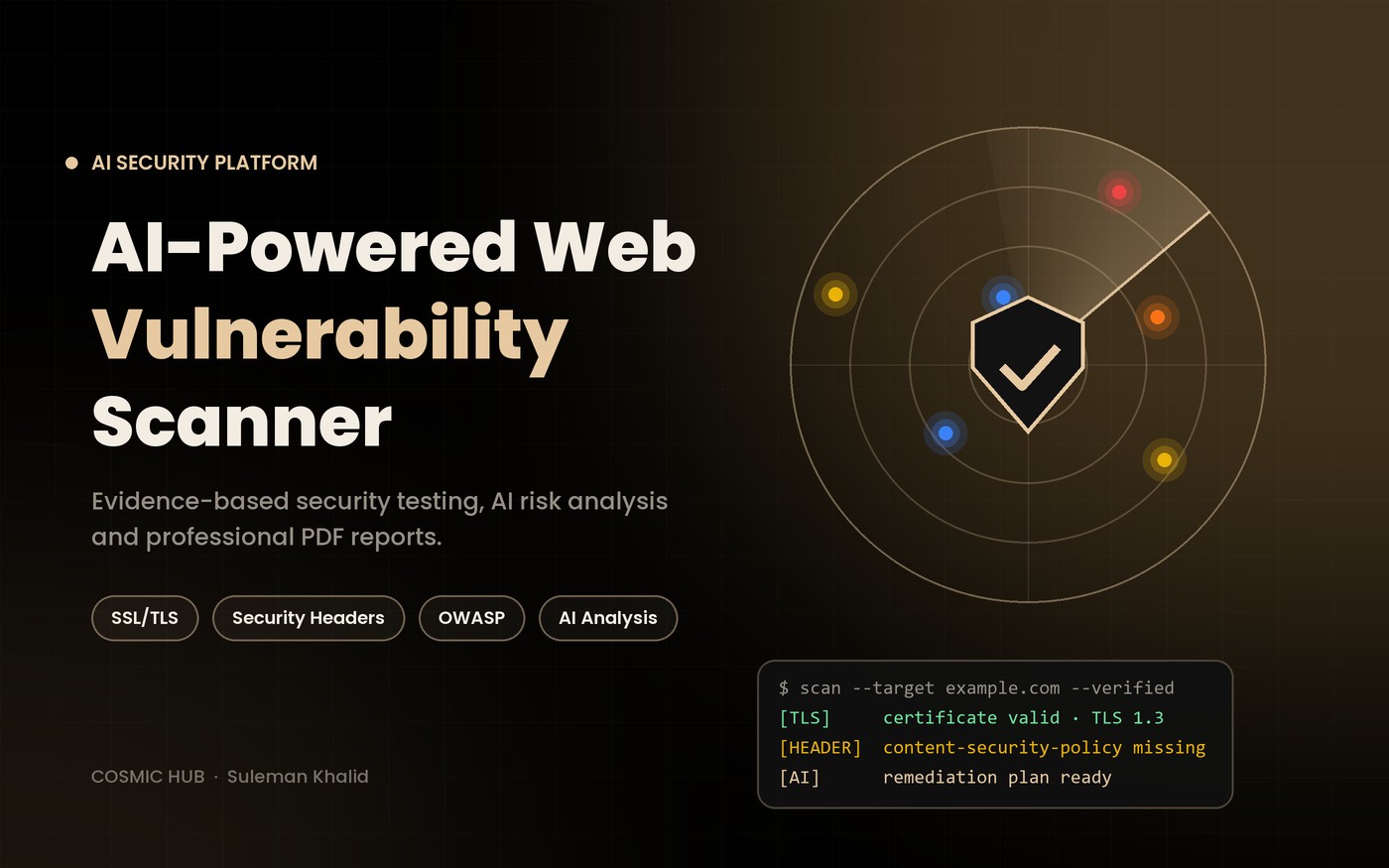
AI-Powered Web Vulnerability Scanner
An AI-powered web security assessment platform designed to identify potential vulnerabilities, analyze website security configurations, and provide intelligent remediation recommendations. It combines automated security testing with AI-assisted vulnerability analysis to help website owners understand and improve their website security.
Check your website's security
Enter your website address. The scanner visits your homepage like a normal browser and checks HTTPS, certificate, security headers, cookies and information leaks, then shows a score with fixes.
Security answers a website owner can act on
Most small business websites in Pakistan are never tested after launch. Commercial scanners are expensive and their reports are hard to read. This platform was built to close that gap with honest, evidence-based results written in plain language.
Find real weaknesses
Detect misconfigurations and vulnerabilities that attackers actually use.
Prove every finding
Store the request, response and indicator behind each result. No guesswork.
Explain clearly
Use AI to translate technical evidence into impact and fix steps.
Test responsibly
Only non-destructive checks, and active tests only on verified domains.
One private dashboard for the full assessment
Real scanning engine
Server-side checks for TLS, headers, cookies, configuration and input handling.
AI security analysis
Every finding explained with impact, confidence and step-by-step remediation.
Domain verification
DNS TXT or HTTP file proof of ownership before any active test runs.
Scan history & comparison
See which issues are new, which were fixed and which still remain.
Security analytics
Score trends, severity charts and OWASP Top 10 distribution across scans.
Branded PDF reports
Summary, statistics, evidence, AI explanations and fixes in one document.
What the scanner checks
A · SSL/TLS analysis
Passive- HTTPS availability and HTTP to HTTPS redirect
- Certificate trust, expiry and host name match
- Negotiated protocol and legacy TLS 1.0/1.1
B · HTTP security headers
Passive- Content-Security-Policy and unsafe sources
- Strict-Transport-Security and max-age
- X-Content-Type-Options, X-Frame-Options, Referrer-Policy, Permissions-Policy
C · Cookie security
Passive- Secure, HttpOnly and SameSite attributes
- Extra weight for session and login cookies
D · Web configuration
Active · verified- Directory listings and exposed .git / .env / config backups
- Server version and CMS version disclosure, debug logs, phpinfo
- Mixed content, insecure forms, CORS and HTTP methods
E · Application vulnerability checks
Active · verified- Potential Cross-Site Scripting: an inert HTML marker tests whether input is returned without encoding
- Potential SQL injection indicators: database error messages triggered by a single quote, compared against a clean baseline
- Sensitive information exposure and common OWASP Top 10 weaknesses
Results are labelled Confirmed, Potential (needs manual verification) or Informational. Nothing is exploited, modified, deleted or extracted.
AI that explains, never invents
After a scan, the findings and the exact evidence behind them are sent to Claude (Anthropic) from the server. The AI writes an overall assessment with priorities, and for each finding returns a clear explanation, the realistic impact, a confidence level and practical fix steps for the site’s platform.
A built-in AI security assistant also answers follow-up questions using the latest scan as context.
Guardrails
- AI only sees real scanner evidence
- It cannot add findings or upgrade a “potential” result to confirmed
- Possible false positives are called out
- The API key stays encrypted on the server, never in the browser
- Built-in explanations still work if AI is unavailable
Five levels, every one backed by evidence
Every finding records severity, confidence, evidence, affected URL or component, remediation, OWASP category, detection time and an estimated CVSS 3.1 score where a real vulnerability exists.
From domain to report
- Verify ownershipAdd the domain and prove control with a DNS TXT record or an HTTP verification file.
- Safe target validationThe address is resolved and checked; private networks, cloud metadata and internal hosts are blocked.
- Passive analysisTLS, headers, cookies, disclosure and content are analysed from a normal page visit.
- Controlled active checksOn verified domains only: exposure probes and input-handling tests, limited in rate and scope.
- Scoring & comparisonA 0-100 score and grade, compared with the previous scan: new, resolved and remaining issues.
- AI analysis & PDFPlain-language explanations and a branded PDF report for the website owner.
Built to run securely on standard hosting
Back end
Security
AI
Front end
Who it helps
Small businesses
A clear picture of website risk without hiring a full penetration test.
Web developers
Check a site before handover and fix issues before clients find them.
Agencies
Track many client websites and show progress with before/after reports.
Students & learners
See how OWASP risks look in real HTTP evidence, explained step by step.
Want a security check of your website?
The scanner is a private tool used for authorised assessments. I will verify ownership, run the scan and walk you through the report.